
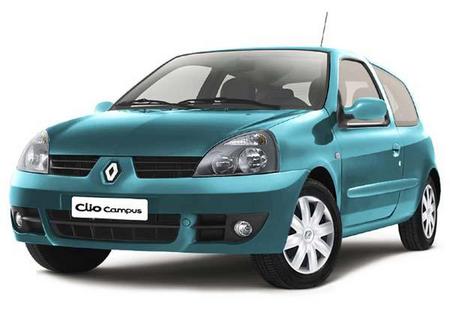
The Renault Clio is a supermini car produced by the French automobile manufacturer Renault. Originally launched in 1990, it is currently in its third generation. The Clio has seen substantial critical and commercial success, being consistently one of Europe's top-selling cars since its launch, and it is largely credited with restoring Renault's reputation and stature after a difficult second half of the 1980s. Symbol of its success and its longevity, the Clio is the only car to have been elected European Car of the Year twice, in 1991 and in 2006. The Clio has been sold as the Renault Lutecia in Japan, as Honda owns the right to the name Clio (being one of Honda's sales networks in Japan). A four-door saloon was developed for certain markets where sedans are traditionally preferred over hatchbacks and is sold under names Renault Clio Classic, Renault Clio Symbol, Renault Symbol, Renault Clio Sedan, Renault Clio Tricorps, and Renault Thalia. It is also sold under the Nissan nameplate in some Latin American markets as the Nissan Platina with slight changes in the front of the car to make it resemble the Nissan Altima.
The Clio was introduced at the Paris Motor Show in June 1990 and sales in France and the rest of the continent began then, although sales in Britain did not begin until March 1991. The Clio largely replaced the Renault 5 (which continued to be built in lower volumes until 1996 in Slovenia as a budget alternative). The engine range available at launch included 1.2 L and 1.4 L E-type "Energy" petrol I4 engines (first seen in the R19) and 1.7 L and a 1.9 L diesel (both based on the F-type unit) engines. The petrol engines all received an electronic fuel injection system in place of carburettors in 1992, in order to conform to new pollutant emission regulations. A minor trim facelift occurred after only a year of being on sale. A new "smooth" version of the Renault diamond badge (the previous "ribbed" badge was being phased out at the time) and a new front seat design were the only changes. The altered design did not constitute a new "phase". In March 1993, the Phase 2 model was launched, with small updates to the exterior and interior of the Clio. Most noticeable was the change in the front grille from two metal ribs to a single colour-coded slat grille. The bump strips were made slightly larger and rounder, and the car's trim level badge was incorporated into the bump strips. The badges on the tailgate strip were moved up onto the tailgate itself and the tailgate strip was given a carbon fibre look. The rear light clusters were given a slightly more rounded bubble shape to them, giving the Clio a more modern look. The clusters, however, are physically interchangeable with Phase 1 clusters.

Renault also released a warm hatch version of the Clio. It was aesthetically very similar, but with the addition of a 110 PS (81 kW) 1.8 L 8-valve engine, side skirts and disc brakes on all wheels. This was badged as the RSi. During 1991, a 1.8 L 16-valve engine producing 137 PS (101 kW) (also first seen in the R19) capable of propelling the car to 208 km/h (129 mph) was introduced to the Clio engine range, known simply as the Clio 16S in France (S for "soupapes", the French word for valves), and Clio 16V in export markets. As well as having higher top speed than a regular Clio, the 16S sported wider plastic front bumpers, an offset bonnet vent, wider rear bumpers and uprated suspension and brakes, and colour-coded front mirrors and bumpers. The RSi side skirts were omitted, however. Interior wise, the 16V model had an extended instrument panel that housed dials for engine oil pressure, oil temperature, and oil level (which only indicates on engine start). The seats were also more supportive to match the sporting nature of the model.


 The Renault Clio is a supermini car produced by the French automobile manufacturer Renault. Originally launched in 1990, it is currently in its third generation. The Clio has seen substantial critical and commercial success, being consistently one of Europe's top-selling cars since its launch, and it is largely credited with restoring Renault's reputation and stature after a difficult second half of the 1980s. Symbol of its success and its longevity, the Clio is the only car to have been elected European Car of the Year twice, in 1991 and in 2006. The Clio has been sold as the Renault Lutecia in Japan, as Honda owns the right to the name Clio (being one of Honda's sales networks in Japan). A four-door saloon was developed for certain markets where sedans are traditionally preferred over hatchbacks and is sold under names Renault Clio Classic, Renault Clio Symbol, Renault Symbol, Renault Clio Sedan, Renault Clio Tricorps, and Renault Thalia. It is also sold under the Nissan nameplate in some Latin American markets as the Nissan Platina with slight changes in the front of the car to make it resemble the Nissan Altima.
 Renault also released a warm hatch version of the Clio. It was aesthetically very similar, but with the addition of a 110 PS (81 kW) 1.8 L 8-valve engine, side skirts and disc brakes on all wheels. This was badged as the RSi. During 1991, a 1.8 L 16-valve engine producing 137 PS (101 kW) (also first seen in the R19) capable of propelling the car to 208 km/h (129 mph) was introduced to the Clio engine range, known simply as the Clio 16S in France (S for "soupapes", the French word for valves), and Clio 16V in export markets. As well as having higher top speed than a regular Clio, the 16S sported wider plastic front bumpers, an offset bonnet vent, wider rear bumpers and uprated suspension and brakes, and colour-coded front mirrors and bumpers. The RSi side skirts were omitted, however. Interior wise, the 16V model had an extended instrument panel that housed dials for engine oil pressure, oil temperature, and oil level (which only indicates on engine start). The seats were also more supportive to match the sporting nature of the model.

No comments:
Post a Comment